

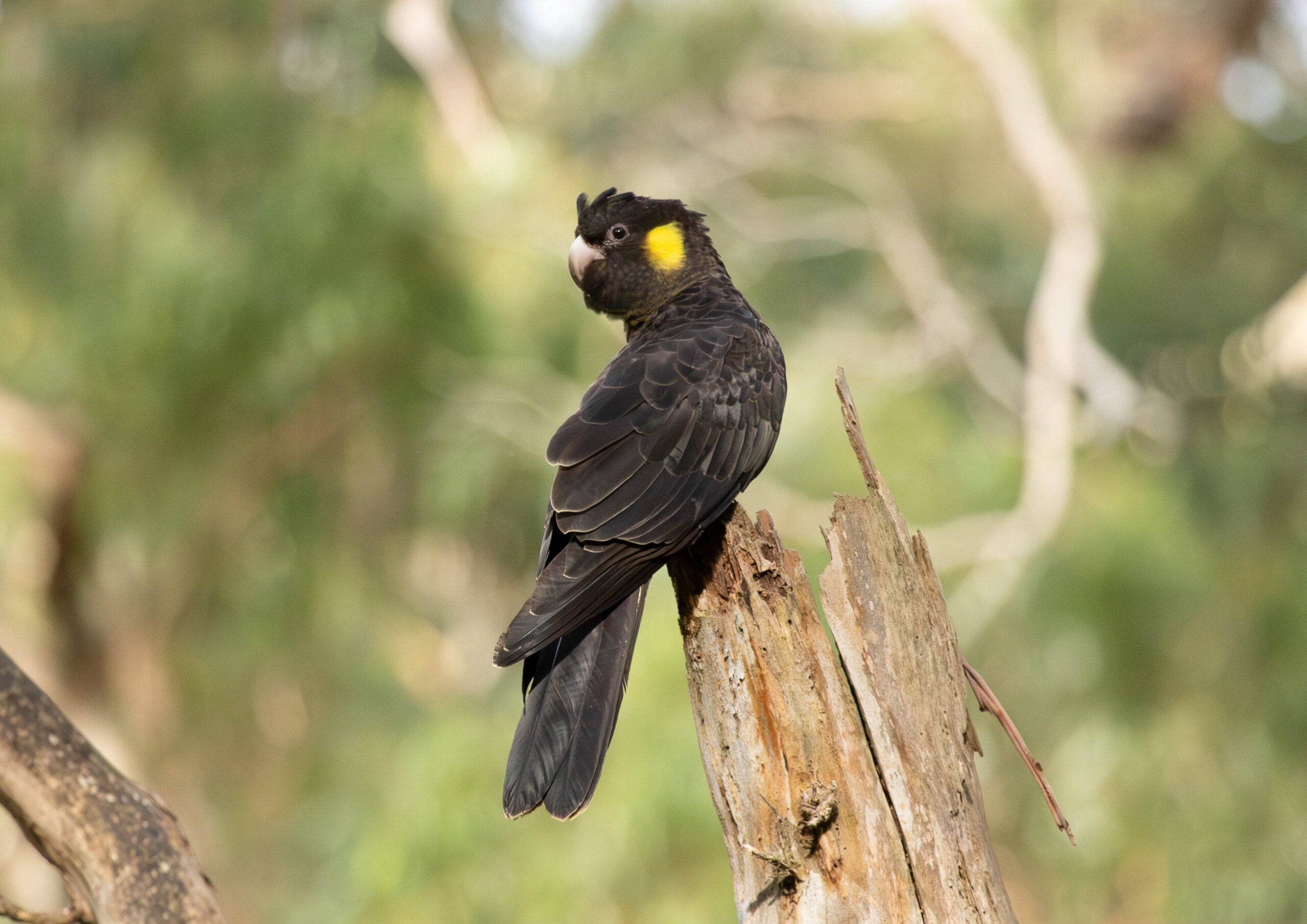

In the tall forests and coastal heathlands of southeastern Australia, the Yellow-tailed Black Cockatoo (Zanda funerea) announces its presence with a long, wailing call that drifts hauntingly across valleys and ridges. These striking birds, with their golden flashes of plumage and graceful, deliberate wingbeats, are among the most iconic cockatoos of the east. Often travelling in small family groups or loose flocks, they bring life and sound to forests that depend on their presence as much as they depend on the forests.
Identification
The Yellow-tailed Black Cockatoo is a large bird, measuring 55-65 cm in length with a wingspan exceeding 1.2 metres. Its plumage is mostly black, subtly scalloped with dark grey, but enlivened by bright golden-yellow cheek patches and a bold panel of yellow feathers in the tail – the feature for which it is named. Its long, pointed tail sets it apart from Baudin’s and Carnaby’s cockatoos of Western Australia. Males can be distinguished by their dark bills and pinkish eye-rings, while females have pale bills and grey eye-rings.
Habitat and Distribution
Zanda funerea occurs along the eastern seaboard of Australia, from southeastern Queensland through New South Wales, Victoria and into Tasmania. It inhabits a wide variety of environments, including coastal heathlands, open forests, wet and dry sclerophyll forests, pine plantations and rainforest edges. The species is particularly reliant on large hollow-bearing eucalypts for nesting, while foraging often takes place in both native forests and plantations of exotic pines (Pinus radiata), which provide abundant seeds.
Ecological Role
Yellow-tailed Black Cockatoos are specialised seed predators, feeding on the woody cones of hakeas, banksias and casuarinas, as well as the seeds of both native and plantation pines. They also feed on insect larvae, particularly wood-boring grubs extracted from the trunks of trees with their powerful beaks. In consuming seeds, they shape plant communities, while their excavation of timber for insects accelerates natural processes of decay and nutrient cycling in forests. They are a keystone species, influencing both plant and invertebrate dynamics.
Behaviour and Reproduction
These cockatoos are highly social and mobile, often travelling in small flocks of 5-15, though larger congregations occur at rich feeding sites. Their calls – long, mournful “kee-ah” notes – are distinctive and carry over great distances. Flight is strong but slow, with deep, deliberate wingbeats that lend them an air of unhurried confidence.
Breeding occurs from July to January. Pairs nest in deep hollows of large, mature eucalypts, often choosing trees hundreds of years old. Clutches usually contain one or two eggs, though only one chick is generally raised successfully. The young remain dependent for many months, with strong family bonds carrying into flock dynamics.
Conservation Status
The Yellow-tailed Black Cockatoo is listed as a species of Least Concern at a national scale, due to its broad distribution. However, in parts of its range, especially in Victoria and Tasmania, local populations are declining due to habitat loss and reduced availability of nesting hollows. In these regions, the species is subject to additional monitoring and regional conservation concern.
Threats
The main threats are habitat loss and fragmentation, particularly the removal of large hollow-bearing eucalypts, which can take centuries to form. Conversion of native forests into agricultural or urban land reduces both nesting and foraging resources. While cockatoos have adapted to feeding in pine plantations, the harvesting of plantations without replacement reduces long-term food security. Predation of eggs and chicks by possums, currawongs and invasive species such as feral bees further impacts breeding success. Road mortality and illegal shooting also occur.
Conservation Efforts
Conservation initiatives include protecting mature forest habitats, promoting the retention of old hollow-bearing trees and installing artificial nest boxes in areas with depleted hollows. In regions such as Victoria, targeted management has focused on maintaining a balance between cockatoo feeding and forestry practices in pine plantations. Community science projects, including bird counts and monitoring, help track population changes. Public education campaigns emphasise the cockatoo’s ecological role and encourage habitat restoration.
Final Thoughts
The Yellow-tailed Black Cockatoo is both haunting and magnificent – its cries echoing through the forests like the voice of the land itself. It is a species that bridges the old and the new, feeding on both native banksias and exotic pines, yet still utterly reliant on ancient trees for its survival. To protect Zanda funerea is to safeguard not only an iconic bird but also the living architecture of forests, where towering eucalypts hold both the future of cockatoos and the memory of centuries past.
Fauna Resources specialises in the safe handling of a range of different fauna species, through safe, effective and ethical fauna solutions. By providing dedicated fauna services, through passionate fauna spotter catchers and fauna specialists, we can support the unique terrestrial ecosystems and rich biodiversity Australia has to offer.
For more information about our specialist fauna services contact Fauna Resources today.